Engineering Science
Associate in Science (A.S.)
Identify and solve problems with a degree in Engineering Science. Discover how to conduct experiments that make the future more efficient and sustainable using the combined power of math, science, and technology.
Career Outlook: Engineering
Advancements in technology, product design, and manufacturing require skilled engineers at every step of the process. Engineers innovate, design, and create new software and technology in a variety of areas. You'll find employment opportunities in the mechanical, electrical, civil, chemical, nuclear, industrial, and biomedical fields. In fact, the U.S. Bureau of Labor Statistics expects 6% growth in engineering careers by 2030. The annual wage for engineers ranges from $80,000 to $100,000 as of May 2021.
A.S. Program Overview
This program introduces you to the fundamentals of engineering, so you can pursue a four-year degree in a specialization of your choice. Courses include calculus, physics, chemistry, engineering graphics, programming, mechanics, thermodynamics, electric circuits, strength of materials, and engineering design.
Hands-on Learning at the Victor Campus Center
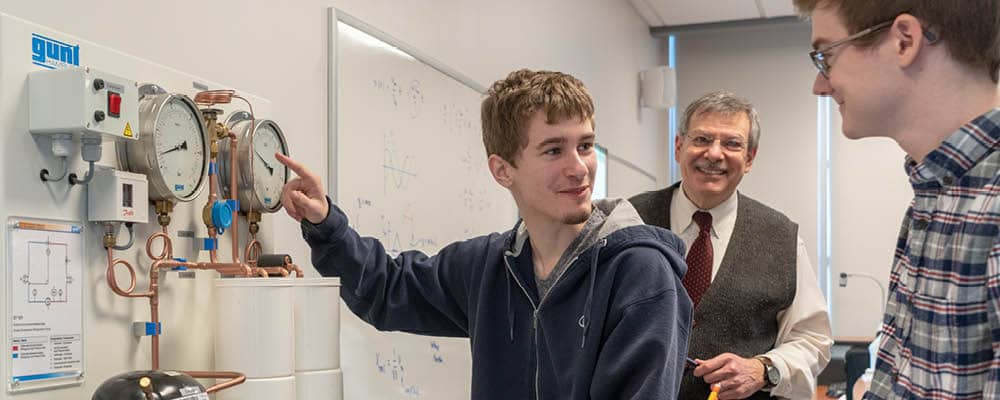
Complete the majority of your coursework and gain hands-on engineering experience at the Victor Campus Center. This state-of-the-art facility includes an engineering lab that is equipped with modern technology, and engineering tools used in the workplace, including:
- Subsonic wind tunnel
- Tensile testing machine
- Refrigeration demo unit
You'll also have access to a full range of electronic equipment, a Computer Aided Design (CAD) lab, a full-size CNC milling machine, and 3D printers.
Engineering and Technology Club
Join the Engineering and Technology club to get involved with technical projects outside the classroom. Learn about the real-world applications of engineering from industry experts by attending lectures and visiting local manufacturing facilities and technical labs.
Our Engineering Science Degree is Available 100% Online
The A.S. Engineering Science degree is available 100% online. With online learning, you can study on your time and from a location that fits your busy schedule. Choose this convenient and flexible way to earn an education. Learn more about FLCC online learning.
A.S. Program Outcomes
Program Learning Outcomes
Upon completion of this degree program, students will be able to:
- Apply principles of math and physics tools to engineering topics.
- Solve foundational engineering problems related to mechanics and electricity.
- Integrate engineering skills of analysis, computing, and graphics into an applied engineering design project.
- Communicate the results of engineering problems effectively to peers and supervisors.
Seamless Transfer Opportunities
Pursue additional education in a variety of engineering fields, such as mechanical, aerospace, civil, chemical, industrial, or nuclear engineering. Graduates have successfully transferred to four-year institutions, including:
- Alfred University
- Clarkson University
- Cornell University
- Rensselaer Polytechnic Institute
- Rochester Institute of Technology
- SUNY Binghamton
- SUNY Buffalo
- University of Rochester
SUNY Two Year Engineering Science Association Member
FLCC is a member of the SUNY Two Year Engineering Science Association (SUNY-TYESA). The association creates partnerships between two-year engineering programs and four-year engineering schools to simplify the transfer process.
Four-Year Career Pathways
With a four-year or advanced degree in this field, you'll be prepared to explore occupations in a variety of subfields, including:
- Civil Engineering
- Electrical Engineering
- Industrial Production Management
- Mechanical Engineering
- Quality Control System Management
- Software Development
Low-Cost Tuition and Scholarship Opportunities
Earn a quality education at an affordable rate. With our low cost-per-credit and general scholarship opportunities, you can maximize your potential with minimal debt. 80% of students are awarded scholarships or financial aid that help with the cost of college.
Faculty
Selim Araci is the lead instructor for Engineering Science. He holds a Ph.D. in Mechanical Engineering from SUNY Buffalo and has been teaching at FLCC since 1987. Selim is a NASA Faculty Fellow and the current president of the Two Year Engineering Science Association.
FLCC's Engineering Science faculty bring to the classroom a strong desire to see their students succeed. From designing and fabricating new or modified components to NASA-sponsored jet engine research, our faculty are incredibly experienced in their respective fields. Learn more about the Engineering Science faculty.
Explore Your Career Options
Map out a path toward your future career, and discover opportunities related to this area of study.
"FLCC prepared me for higher education by gradually easing me into more challenging coursework and expectations, and provided me a strong base in the fundamentals of engineering."