Nursing Programs
FLCC offers multiple nursing pathways tailored to meet your individual needs and ambitions. Whether you're just getting started in healthcare or looking to advance in your career, our degree and certificate programs (RN, LPN, and LPN-to-RN) will help you take that next step.
Nursing Programs at FLCC
A.A.S. Nursing — Become a Registered Nurse (RN)
Our conventional A.A.S. Nursing program is held during the day at our main campus in Canandaigua. This track is intended for:
- Students entering college from high school who have selected nursing as a career.
- Transfer students who have completed some college courses and want to begin a nursing career.
- Adult students seeking a second degree in nursing as a career change.
A.A.S. Nursing — Registered Nurse
A.A.S. Nursing — LPN to RN Accelerated Option
We offer an accelerated option for licensed practical nurses (LPNs). After appropriate testing, LPNs may be granted advanced standing in FLCC’s Nursing program. This option reduces repetitive coursework for qualified students and shortens the time it takes to earn a degree.
A.A.S. Nursing — Accelerated LPN to RN
Licensed Practical Nursing (LPN) Certificate Program
LPNs play a crucial role in providing direct patient care in a variety of healthcare settings. To receive an LPN license, you'll study biology, pharmacology, and nursing and complete supervised clinical experiences. The LPN certificate program can be completed in as little as 12 months.
Licensed Practical Nursing Certificate
Career Outlook: Nursing and Healthcare
Employment in healthcare occupations is projected to grow much faster than the average for all occupations from 2022 to 2032. This positive outlook makes it an ideal time to pursue a career in nursing. Healthcare is an essential economic driver in upstate New York, where many major employers are hospitals and long-term care facilities.
Learn from Experienced Nurses and Healthcare Professionals
Each full-time Nursing faculty member has a master's degree in Nursing. They bring several years of clinical experience to the classroom. In addition to their faculty roles, many continue to work in acute and public healthcare settings. A number of the faculty have advanced certifications in specialty areas that go above and beyond a standard nursing education.
Our faculty are life-long learners who dedicate time each year to continuing their own education. They engage in professional development activities to remain on the cutting-edge of healthcare practices.
State-of-the-Art Nursing Facilities
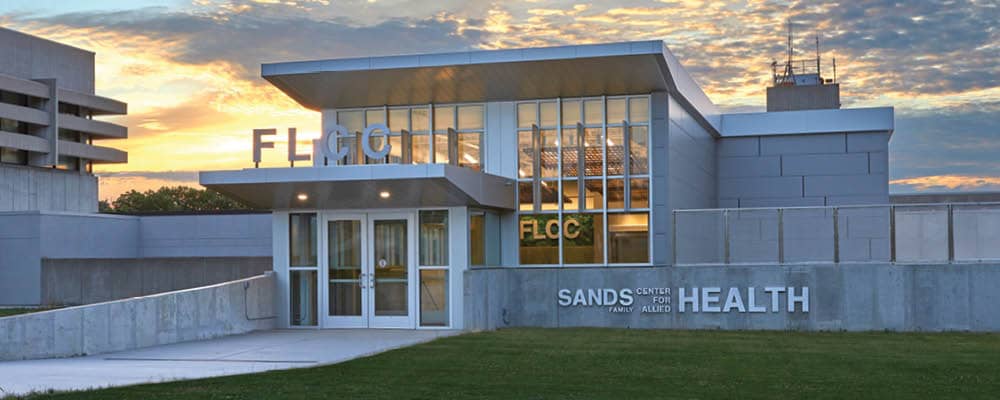
Learn and practice in our newly renovated and expanded Sands Family Center for Allied Health. Our hands-on nursing facilities feature:
- Simulation labs that look and feel like real hospital rooms.
- Debriefing rooms to review student demonstrations with faculty.
- HoloLens equipment using virtual reality to study human anatomy.
- Science Incubator for group study and professional tutor support.
Mandatory Professional Licensure Disclosures:
SUNY's academic programs leading to licensure or certification are carefully designed to meet and exceed New York State requirements. Other states may have their own requirements. If your goal is to practice in another state, please review that state's requirements. View professional licensure disclosures.
FLCC Accreditation Status:
FLCC's program is accredited by the Accreditation Commission for Education in Nursing, 3390 Peachtree Road NE, Suite 400, Atlanta, Georgia 30326. Telephone: (404) 975-5000

Explore Your Career Options
Map out a path toward your future career, and discover opportunities related to this area of study.